
17 Dez 2024
How to judge a regenerative agriculture certification programme
As regenerative agriculture’s momentum continues to grow, the number of certification programmes on the […]Ver pormenores

31 Mar 2026
At True Foam Pvt Ltd, our vision has always been to prioritise complete supply chain transparency and active environmental restoration. We shifted towards a regenerative culture because we knew we had to work to heal the land, as well as supporting those who farm it.
Why True Foam works with Regenagri
We chose to work with Regenagri because its principles go beyond conventional sustainability standards. Its framework provides a highly structured pathway to support smallholder rubber farmers in Sri Lanka, promoting regenerative agricultural practices that actively restore soil health, improve biodiversity, and strengthen climate resilience.
Achieving Regenagri certification for our True Rubber farms is a monumental step in healing the land and empowering our farmers in Sri Lanka. For too long, the industry has relied on extraction. By partnering with Regenagri, we are proving that absolute transparency is possible, and that True Foam can create premium regenerative latex products while actively restoring ecosystems and uplifting rural communities.”
– Uthpala Madusankhani, Operation and Compliance Executive – Field latex, True Foam
Ultimately, we recognise that rubber is not just agriculture; it is a unique intersection of forestry, industry, and a vital pillar of our export economy. Regenagri helps us to protect all three of these elements.
Bringing the land back to life while improving latex quality
On our True Rubber farms in Sri Lanka’s Monaragala District, the most beautiful change has been watching the land come back to life, which has had a direct, measurable impact on the quality of our product.
By shifting to Regenagri’s agroforestry model, our farms now act like natural forests. This approach protects the topsoil and significantly improves tree health, extending the life of the rubber trees so they can produce stable, high-quality latex for 25–30 years.
While working towards Regenagri certification, we monitored and categorised our farms based on their level of regenerative practices. For example, “Type 01” farms exhibit:
Through monitoring, we observed that Type 01 farms produce more consistent latex quality throughout the year when compared with lower-category monoculture farms.
Before, we only grew rubber, and the soil was dry. Now, with the training and support from True Foam’s farm group, we grow bananas, cocoa, and coffee alongside our trees. The soil holds water again, the wildlife has returned, and my family has extra income from the other crops. We feel like we are taking care of a forest, not just a farm, and the latex we tap is healthier for it.”
– Mr. Sumith Bandara, Rubber farmer
Currently, every one of our registered farms is operating within these higher regenerative categories. Thanks to their improved water and pollution management, the latex they supply consistently yields a higher Dry Rubber Content (DRC) and excellent Volatile Fatty Acid (VFA) stability.
At the manufacturing level within True Foam, our optimised processes ensure these incredible farm-level benefits are rigorously preserved throughout the entire production cycle.
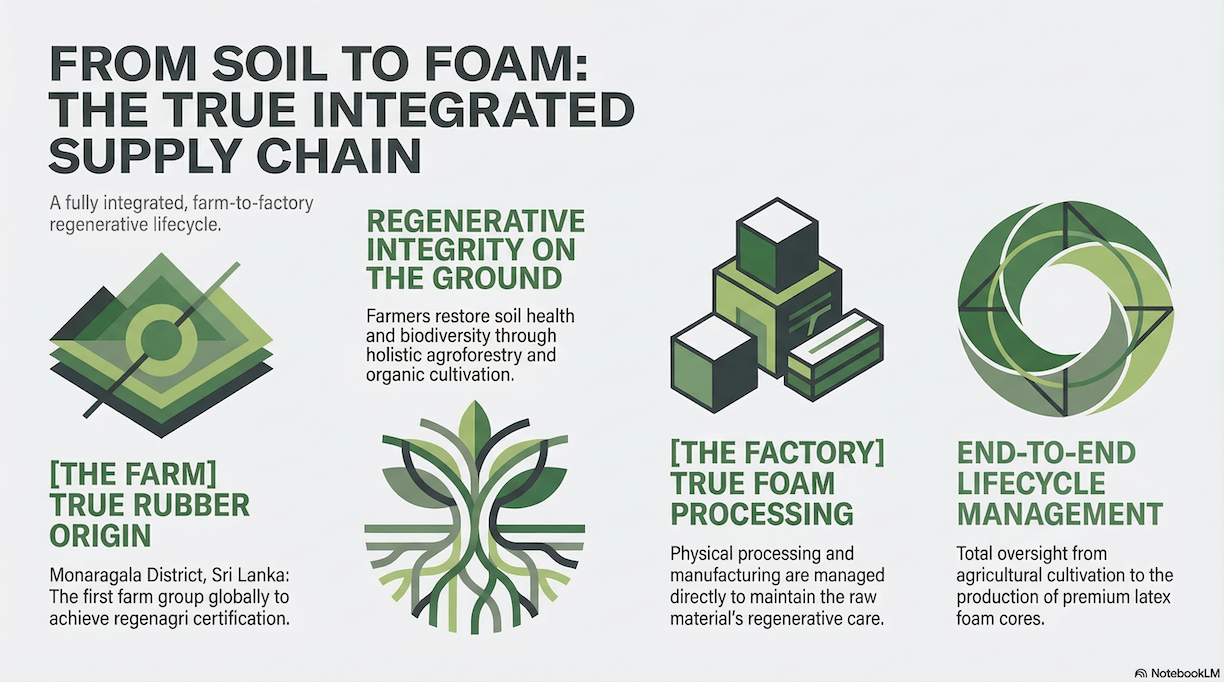
Reaping the benefits: True Foam’s regenerative journey so far
Adopting Regenagri has allowed True Foam to evolve from a sustainable manufacturer into a community-driven pioneer. We have developed a highly robust internal control system that guarantees every batch of latex is 100% traceable from our centralised factory back to the specific, GPS-logged plot of the farmer who tapped it. We are improving our own supply chain while driving systemic socio-economic change.
For our farms, introducing regenerative systems has reduced dependency on chemical fertilisers and pesticides, lowering farming costs over time while securing stable income through better long-term yields. Furthermore, Regenagri certification opens the door to higher premium prices that international companies are willing to pay for regeneratively grown rubber.
For Sri Lanka, this initiative provides robust rural employment, drives vital environmental protection and carbon capture, generates sustainable export income, and supports the domestic rubber product manufacturing industry.
We are proving that a fully integrated business model that prioritises the health of the earth, the physical quality of the natural materials, and the prosperity of rural communities, can successfully scale.
17 Dez 2024
Ver pormenores

03 Jun 2025
Ver pormenores

24 Nov 2025
Ver pormenores

 English English
  German
 Italian
 Portuguese
 Hindi
Hindi
 Romanian
 Hungarian
 Ukrainian
 French
 Spanish
 Chinese